Digitale Präsenz stärkt Zugehörigkeit
Beziehungsgestaltung durch AV1-Telepräsenzroboter und Mentalisieren
DOI :
https://doi.org/10.57161/z2026-01-06Mots-clés :
communication, émotivité, inclusion, interaction sociale, maladie, participation, relation maitre-élève, robot de téléprésence, technologie d'aideRésumé
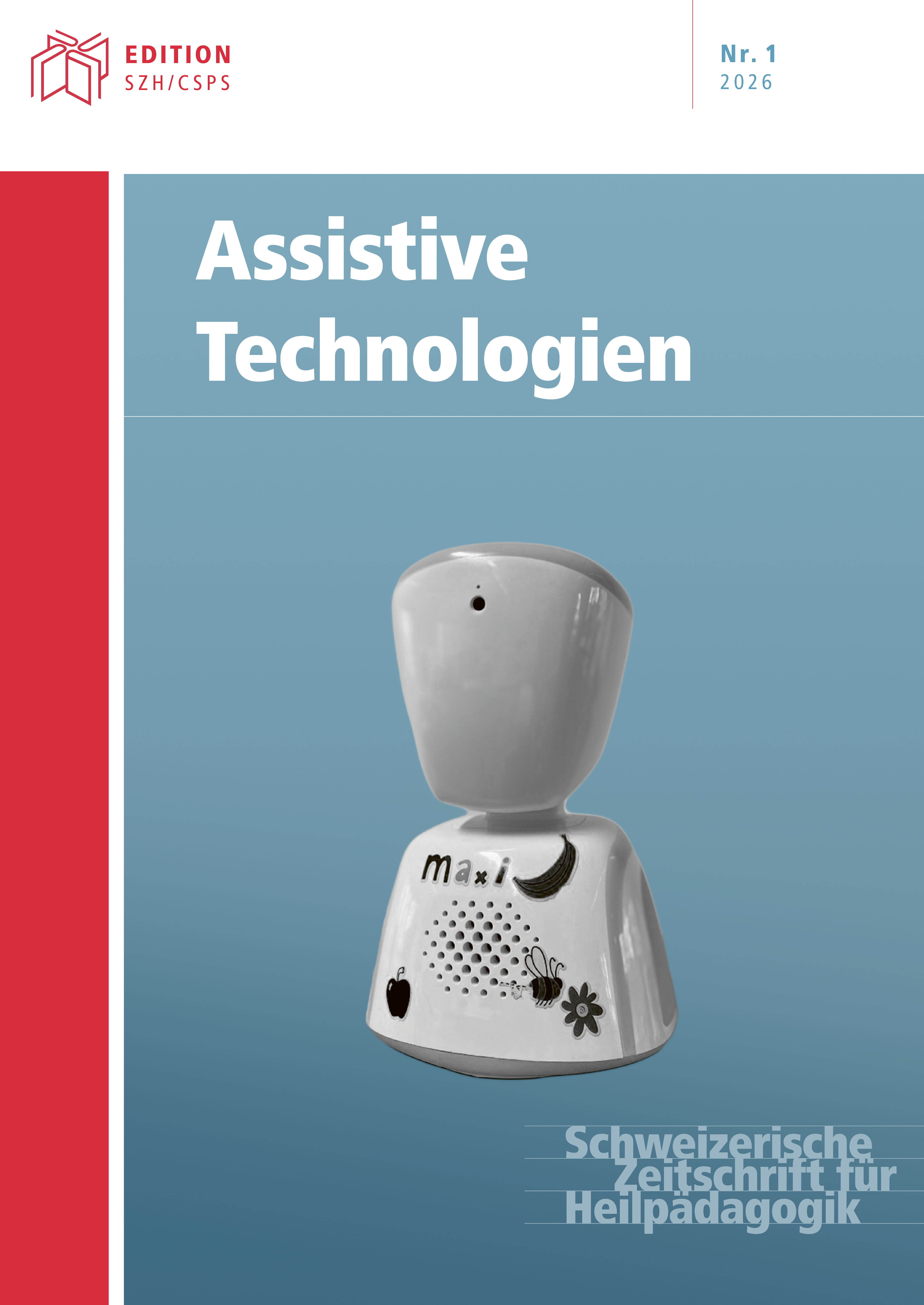
Les robots de téléprésence tels que l’AV1 garantissent non seulement l’accès à l’enseignement, mais peuvent également renforcer le sentiment d’appartenance. Toutefois, selon des études internationales et des exemples pratiques, la technologie seule ne suffit pas. Grâce à une approche basée sur la mentalisation, le corps enseignant et les élèves parviennent à percevoir leur état intérieur, refléter les émotions perçues et façonner consciemment les interactions. Dans cet article, nous présentons la théorie et les données empiriques relatives à l’appartenance et à la mentalisation. À l'aide d'une vignette clinique, nous montrons également comment la présence numérique peut se traduire en participation active. Pour cela, un accompagnement pédagogique et des conditions-cadres claires sont nécessaires. En partant de celles-ci, nous déduirons des recommandations pour les écoles.
Références
Allen, K. A. & Kern, M. L. (2017). School belonging in adolescents: Theory, research and practice. Springer.
Børsting, J. & Culén, A. L. (2016). A robot-avatar: Easier access to education and reduction in isolation? Proceedings of the IADIS International Conference e-Health 2016 (pp. 34–44). International Association for Development of the Information Society. https://3408150.fs1.hubspotusercontent-eu1.net/hubfs/3408150/Peer%20reviewed%20articles/B%C3%B8rsting%20&%20Cul%C3%A9n%202016.pdf
Culén, A. L., Børsting, J. & Odom, W. (2019). Mediating relatedness for adolescents with ME: Reducing isolation through minimal interactions with a robot avatar. Proceedings of the 2019 on Designing Interactive Systems Conference (pp. 359–371). Association for Computing Machinery. https://doi.org/10.1145/3322276.3322319
Felder, F. (2024). Partizipation und Zugehörigkeit – Die Achsen des Menschseins. Menschen. Zeitschrift für gemeinsames Leben, Lernen und Arbeiten, 47 (6), 27–32.
Fletcher, M. & Bond, C. (2022). The use of AV1 robot avatars in schools – A tool for inclusion? DECP Debate, 183, 21–29. https://doi.org/10.53841/bpsdeb.2022.1.183.21
Fletcher, M., Bond, C. & Qualter, P. (2024). Using AV1 robots to support pupils with physical and emotional health needs. Educational Psychology in Practice, 40 (1), 74–95. https://doi.org/10.1080/02667363.2023.2269082
Fonagy, P., Gergely, G., Jurist, E. L. & Target, M. (2018). Affektregulierung, Mentalisierung und die Entwicklung des Selbst (6. Aufl.). Klett-Cotta.
Gingelmaier, S., Schwarzer, N.-H., Nolte, T. & Fonagy, P. (2021). Epistemisches Vertrauen – Eine wichtige Ergänzung für die mentalisierungsbasierte (Sonder-)Pädagogik. Menschen. Zeitschrift für gemeinsames Leben, Lernen und Arbeiten, 5, 21–29.
Gingelmaier, S., Taubner, S., Ramberg, A. & Fonagy, P. (2018). Handbuch mentalisierungsbasierte Pädagogik. Vandenhoeck & Ruprecht.
Hughes, G., Moore, L., Hennessy, M., Sandset, T., Jentoft, E. E. & Haldar, M. (2024). What kind of a problem is loneliness? Representations of connectedness and participation from a study of telepresence technologies in the UK. Frontiers in Digital Health, 6, 1304085. https://doi.org/10.3389/fdgth.2024.1304085
Johannessen, L. E. F., Rasmussen, E. B. & Haldar, M. (2023a). Student at a distance: Exploring the potential and prerequisites of using telepresence robots in schools. Oxford Review of Education, 49 (1), 1–18. https://doi.org/10.1080/03054985.2022.2034610
Johannessen, L. E. F., Rasmussen, E. B. & Haldar, M. (2023b). Educational purity and technological danger: Understanding scepticism towards the use of telepresence robots in school. British Journal of Sociology of Education, 44 (4), 703–719. https://doi.org/10.1080/01425692.2023.2203360
Link, P.-C., Fonagy, P., Nolte, T., Langnickel, R. & Kreuzer, T. F. (Hrsg.) (2025). Having Teachers in Mind – Können Schule und Lehrer:innenbildung Freud-los sein? Psychodynamische Perspektiven auf das schulische Feld und seine Grenzgebiete. Budrich. https://doi.org/10.3224/84743146
Neuhauser, A., Röösli, P., Muheim, V., Bräuninger, I. & Link, P.-C. (2024). Psychodynamische Handlungsansätze: Bindung und Mentalisieren. In D. C. Hövel, C. Schellenberg, P.-C. Link & O. Gasser-Haas (Hrsg.), Sozio-emotionales Lernen: Pädagogik sozio-emotionaler Entwicklungsförderung (HfH-Reihe 41, S. 233–244). Edition SZH/CSPS.
Osterman, K. F. (2000). Students’ need for belonging in the school community. Review of Educational Research, 70 (3), 323–367. https://doi.org/10.3102/00346543070003323
Pletschko, T., Pelzer, C., Röhsner, M., Rockenbauer, G. & Turner, A. (2022). The use of the telepresence system AV1 as a therapeutic tool for social inclusion in a 10-year-old girl treated for a brain tumor. Digital Psychology, 3 (1), 18–23. https://doi.org/10.24989/dp.v3i1.2013
Schwarzer, N.-H., Link, P.-C., Behringer, N. & Turner, A. (Hrsg.) (2024). Bindung und Mentalisieren als Aspekte wirksamer pädagogischer Handlungs- und Beziehungskompetenz. Empirische Pädagogik. https://doi.org/10.62350/ZAOU8100
Turner, A., Schults, A., Leesmaa, K., Andersen, M., Søgaard, V., Christiansen, K., Rockenbauer, G., Zillner, C., Sakro-wsky, S., Bienzle, H., Tallon, M., Fernández-Morante, C., Casal-Otero, L. & Cebreiro, B. (2024). Telepräsenzsysteme für die soziale Inklusion von Kindern und Jugendlichen in Zeiten chronischer Krankheit: Ein Handbuch für Lehrer:innen und Praktiker:innen in pädagogischen Arbeitsfeldern. Universität Klagenfurt. https://abiliti.eu/wp-content/uploads/2024/06/Handbook_DE_final-2.pdf
Weibel, M., Bergdahl, N., Hallström, I. K., Skoubo, S., Bertel, L. B., Schmiegelow, K. & Larsen, H. B. (2024). Robots2school: Telepresence-mediated learning in the hybrid classroom – Experiences in education support for children during cancer treatment. Education and Information Technologies, 29, 11339–11366. https://doi.org/10.1007/s10639-023-12243-0
Weibel, M., Nielsen, M. K. F., Topperzer, M. K., Hammer, N. M., Møller, S. W., Schmiegelow, K. & Bækgaard Larsen, H. (2020). Back to school with telepresence robot technology: A qualitative pilot study about how telepresence robots help school-aged children and adolescents with cancer to remain socially and academically connected with their school classes during treatment. Nursing Open, 7 (4), 988–997. https://doi.org/10.1002/nop2.471
Yeo, M. & Sawyer, S. (2005). Chronic illness and disability. The BMJ, 330, 721–723. https://doi.org/10.1136/bmj.330.7493.721
Téléchargements
Publiée
Comment citer
Numéro
Rubrique
Licence
© Agnes Turner, Lisa Neumann, Fabian Wamsler, Pierre-Carl Link, Robert Langnickel 2026

Ce travail est disponible sous la licence Creative Commons Attribution 4.0 International .