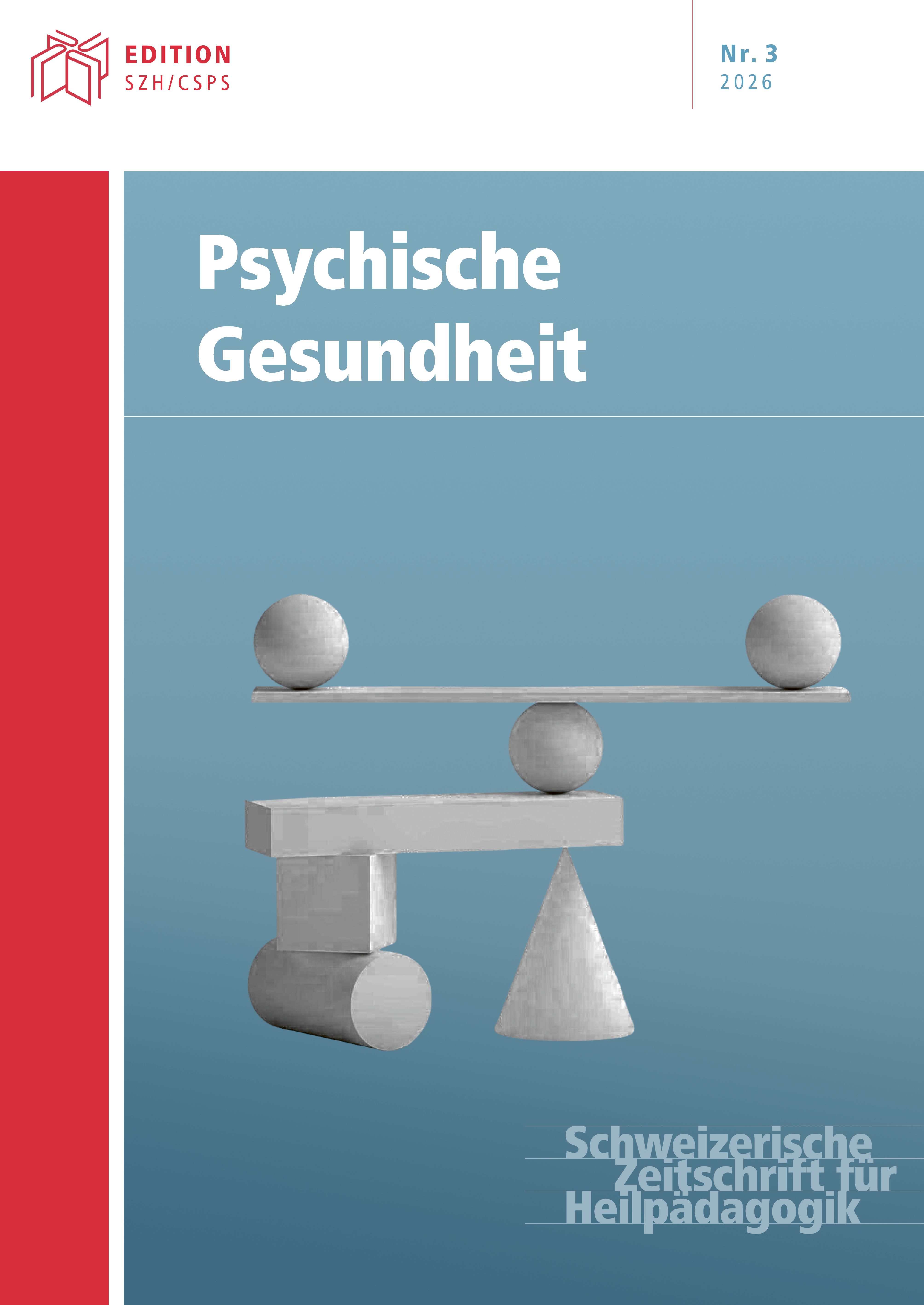
Die mentale Gesundheit von Kindern und Jugendlichen fördern
Best practices aus Entwicklungspsychologie, Pädagogik und Neurowissenschaft
DOI :
https://doi.org/10.57161/z2026-03-06Mots-clés :
auto-efficacité, prévention, psychologie positive, relations interpersonnelles, résilience, santé mentaleRésumé
Cet article examine la santé mentale des jeunes à la zone de tensions entre l’école, la famille et la société. Il montre comment les processus de maturation neurobiologique du cerveau adolescent influencent le comportement, les émotions et la gestion du stress des jeunes et quels défis ils impliquent. Sur cette base, l’article décrit les facteurs de protection d’un point de vue neuro-
scientifique, psychologique et pédagogique. Le corps enseignant et les parents peuvent renforcer la santé mentale des jeunes grâce à la corégulation et à une culture d’apprentissage favorisant la résilience. En complément, deux théories sont présentées : le modèle PERMA de la psychologie positive et la théorie du Mentor-Mindset.
Références
Antonovsky, A. (1987). Unraveling the mystery of health: How people manage stress and stay well. Jossey-Bass.
Barzilay, R., Pimentel, S. D., Tran, K. T., Visoki, E., Pagliaccio, D. & Auerbach, R. P. (2026). Smartphone Ownership, Age of Smartphone Acquisition, and Health Outcomes in Early Adolescence. Pediatrics, 175 (1), e2025072941. https://doi.org/10.1542/peds.2025-072941
Blakemore, S.-J. (2018). Inventing ourselves: The secret life of the teenage brain. PublicAffairs.
Bolier, L., Haverman, M., Westerhof, G. J., Riper, H., Smit, F. & Bohlmeijer, E. (2013). Positive psychology interventions: A meta-analysis of randomized controlled studies. BMC Public Health, 13 (119), 1–20. https://doi.org/10.1186/1471-2458-13-119
Bruch, H., Neu, M. & Egger, M. (2025). St. Galler Jugendstudie 2025: Zwischen Traumjob, Ambition und Social Media. Universität St. Gallen.
Bundesamt für Statistik (BFS) (2023). Psychische Gesundheit. https://www.bfs.admin.ch/bfs/de/home/statistiken/gesundheit/gesundheitszustand/psychische.html [Zugriff: 20.01.2026]
Casey, B. J., Jones, R. M. & Hare, T. A. (2008). The adolescent brain. Annals of the New York Academy of Sciences, 1124, 111–126. https://doi.org/10.1196/annals.1440.010
Engel, G. L. (1977). The need for a new medical model: A challenge for biomedicine. Science, 196 (4286), 129–136. https://doi.org/10.1126/science.847460
Fuchs, M. & Karwautz, A. (2017). Epidemiologie psychischer Störungen bei Kindern und Jugendlichen. Neuropsychiatrie, 31, 96–102. https://doi.org/10.1007/s40211-017-0238-x
Grossmann, K. E., Grossmann, K. & Kindler, H. (2020). Bindungen – das Gefüge psychischer Sicherheit (6. Aufl.). Klett-Cotta.
Gut, J. (2025). Im Gespräch bleiben – Beziehung zu Teenagern stärken. Erziehungskosmos.ch.
Gut, J. (2026). PERMA Workshop Set: Mentale Gesundheit von Jugendlichen stärken. Erziehungskosmos.ch.
Hurrelmann, K. & Quenzel, G. (2022). Lebensphase Jugend. Eine Einführung in die sozialwissenschaftliche Jugendforschung (14. Aufl.). Beltz.
Käferböck, S. (2025). Mentor-Mindset: Motivation fördern und Potenziale entfalten. Kirchliche Pädagogische Hochschule Wien/Niederösterreich.
Kaman, A., Erhart, M., Devine, J., Napp, A.-K., Reiss, F., Behn, S. & Ravens-Sieberer, U. (2024). Mental Health of Children and Adolescents in Times of Global Crises: Findings from the Longitudinal COPSY Study from 2020 to 2024. https://ssrn.com/abstract=5043075 [Zugriff: 20.01.2026]
Luna, B., Padmanabhan, A. & O'Hearn, K. (2009). What has fMRI told us about the development of cognitive control through adolescence? Brain and cognition, 72 (01), 101–113. https://doi.org/10.1016/j.bandc.2009.08.005
Masten, A. S. (2014). Ordinary magic: Resilience in development. Guilford Press.
Nagel, M. (2024). Problematische Smartphonenutzung und kognitive Unterrichtsmeidung bei Jugendlichen der Sekundarstufe I. Zeitschrift für Bildungsforschung, 14, 21–39. https://doi.org/10.1007/s35834-024-00417-w
Pro Juventute (2024). Jugendstudie: Wie es Jugendlichen in der Schweiz heute geht. Pro Juventute Stiftung.
Sanders, M. T., Parton, R. R., Gaspar, H. A., Denial, C. M., Sternberg, K. F., Knight, E. M., Tanski, S. E. & Jankowski, M. K. (2025). A chronic stress and wellbeing screening implementation initiative in pediatric primary care. Clinical Practice in Pediatric Psychology, 13 (4), 373–382. https://doi.org/10.1177/21694826251335638
Schweizerisches Gesundheitsobservatorium (Hrsg.) (2025). Psychische Gesundheit in der Schweiz: Entwicklung, Förderung, Prävention und Versorgung. Nationaler Gesundheitsbericht 2025. BFS. https://www.obsan.admin.ch/sites/default/files/2025-09/ngb2025_de.pdf
Seligman, M. E. P. (2011). Flourish. Simon & Schuster.
Steinberg, L. (2014). Age of opportunity: Lessons from the new science of adolescence. Houghton Mifflin Harcourt.
Waller, G. (2025). Der Medienumgang von Jugendlichen in der Schweiz. Konstanten, Veränderungen und aktuelle Trends. https://public-health.ch/documents/2723/JAMES-Studie_-_Medienumgang_von_Jugendlichen_-_Gregor_Waller_tudZbQl.pdf
Téléchargements
Publiée
Comment citer
Numéro
Rubrique
Licence
© Joëlle Gut 2026

Ce travail est disponible sous la licence Creative Commons Attribution 4.0 International .