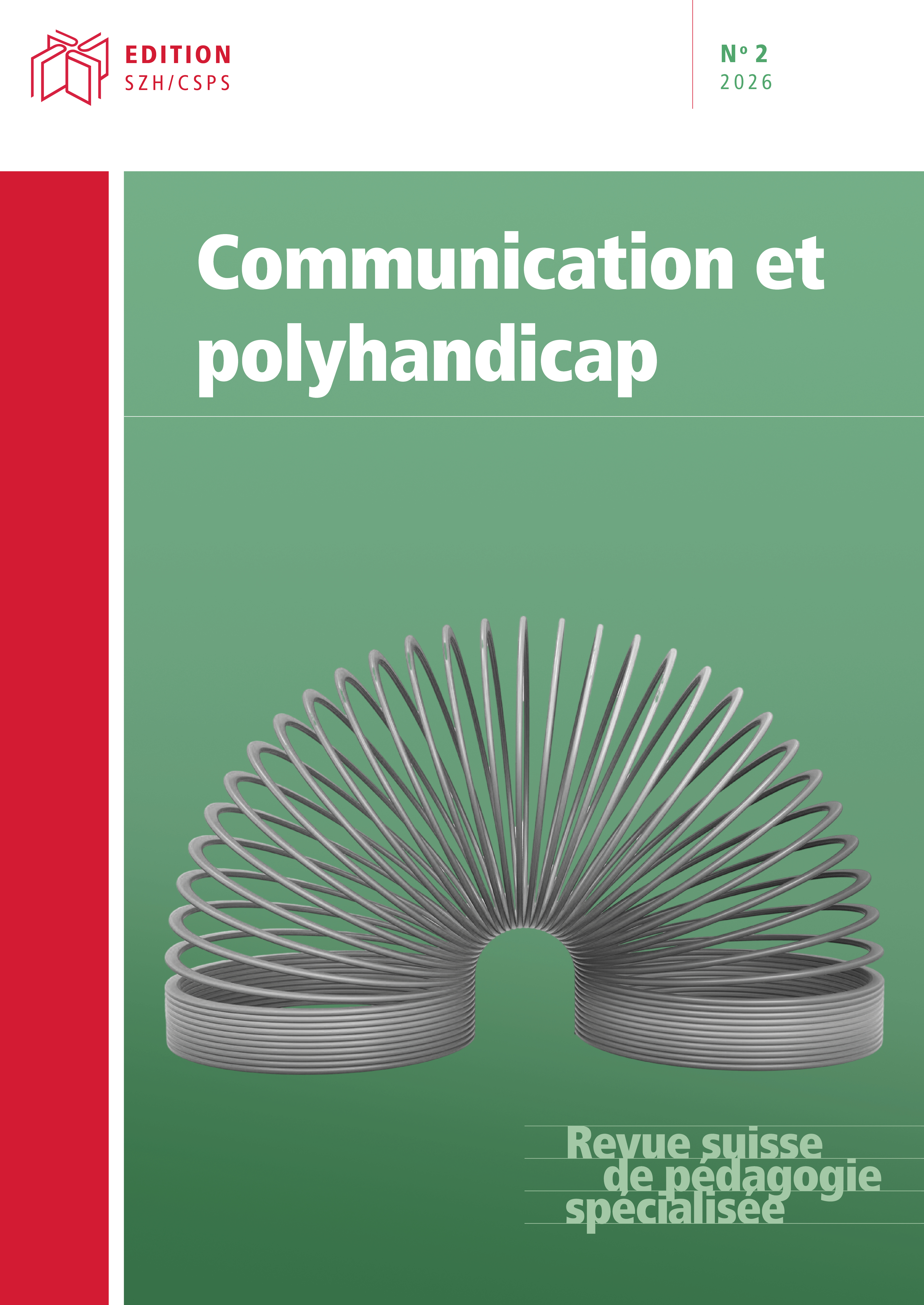
Une meilleure compréhension des besoins des personnes polyhandicapées
Regards croisés des personnes aidantes dans un cadre standardisé
DOI :
https://doi.org/10.57161/r2026-02-03Mots-clés :
communication non verbale, émotion, grille d'observation, parents, personnel, polyhandicapRésumé
Cet article s’intéresse à une étude visant à évaluer la capacité des personnes aidantes à reconnaitre les réactions émotionnelles de personnes polyhandicapées. Pour près de la moitié des résultats, les interprétations des réactions convergent. Cet article aborde l’intérêt d’un cadre standardisé pour objectiver les convergences et les divergences d’interprétation entre les parents et l’équipe professionnelle, servant comme base pour élaborer un référentiel partagé d’interprétation des signaux de communication des personnes polyhandicapées.
Références
Cataix-Negre, E. (2017). Communiquer autrement. Accompagner les personnes avec des troubles de la parole ou du langage (2ème éd.). De Boeck.
Chadwick, D., Buell, S., & Goldbart, J. (2018). Approaches to communication assessment with children and adults with profound intellectual and multiple disabilities. Journal of Applied Research in Intellectual Disabilities, 32(2), 336-358. https://doi.org/10.1111/jar.12530
Engelhardt, M., Krämer, T., Marzini, M., Sansour, T., & Zentel, P. (2020). Communication assessment in people with PIMD. Evaluating the use of the INSENSION Questionnaire – Longform (InQL). Psychoeducational Assessment, Intervention and Rehabilitation, 2(1), 1-14. https://www.universiteitleiden.nl/binaries/content/assets/customsites/enpair/volume-2/engelhardt_etal_vol-2_issue1.pdf
Grove, N., Bunning, K., Porter, J., & Olsson, C. (1999). See What I Mean: Interpreting the Meaning of Communication by People with Severe and Profound Intellectual Disabilities. Journal of Applied Research in Intellectual Disabili-ties, 12(3), 190-203. https://doi.org/10.1111/j.1468-3148.1999.tb00076.x
Hogg, J., Reeves, D., Roberts, J., & Mudford, O. C. (2001). Consistency, context and confidence in judgments of affec-tive communication in adults with profound intellectual and multiple disabilities. Journal of Intellectual Disa-bility Research, 45(1), 18-29. https://doi.org/10.1111/j.1365-2788.2001.00289.x
Hoogsteyns, M., Zaal-Schuller, I., Huisman, S., Nieuwenhuijse, A. M., van Etten-Jamaludi, F., Willems, D., & Kruithof, K. (2023). Tacit knowledge in dyads of persons with profound intellectual and multiple disabilities and their caregivers: An interpretative literature study. Journal of Applied Research in Intellectual Disabilities, 36(5), 966-977. https://doi.org/10.1111/jar.13134
Kamstra, A., van der Putten, A. A. J., Maes, B., & Vlaskamp, C. (2018). Exploring spontaneous interactions between people with profound intellectual and multiple disabilities and their peers. Journal of Intellectual & Develop-mental Disability, 44(3), 282-291. https://doi.org/10.3109/13668250.2017.1415428
Kruithof, K., Hoogsteyns, M., Zaal-Schuller, I., Huisman, S., Willems, D., & Nieuwenhuijse, A. (2024). Parents’ tacit knowledge of their child with profound intellectual and multiple disabilities: A qualitative study. Journal of In-tellectual & Developmental Disability, 49(4), 415-424. https://doi.org/10.3109/13668250.2024.2336084
Landis, J. R., & Koch, G. G. (1977). The measurement of observer agreement for categorical data. Biometrics, 33(1), 159-174. https://jjcurtin.github.io/book_iaml/pdfs/landis_1977_kappa.pdf
Montagner, H. (2012). L’enfant et la communication. Comment gestes, attitudes et vocalisations deviennent des mes-sages. Dunod. https://doi.org/10.3917/dunod.monta.2012.01
Munde, V., & Vlaskamp, C. (2014). Initiation of activities and alertness in individuals with profound intellectual and multiple disabilities. Journal of Intellectual Disability Research, 59(3), 284-292. https://doi.org/10.1111/jir.12138
Petry, K., & Maes, B. (2006). Identifying expressions of pleasure and displeasure by persons with profound and multiple disabilities. Journal of Intellectual and Developmental Disability, 31(1), 28-38. https://doi.org/10.1080/13668250500488678
Van der Maat, S. (1992). Communication between persons with a profound intellectual disability and their primary caregiv-ers. Garant
Zandbelt, L. M., Bakker-van Gijssel, E. J., Coppens, C. H., Draaisma, J. M. T., & Geelen, J. M. (2024). Health problems in children with profound intellectual and multiple disabilities: a scoping review. European Journal of Pediatrics, 184(67), 1-11. https://doi.org/10.1007/s00431-024-05876-x
Zorn, S., Atlan, E., Martel, K., Puustinen, M., Lewi-Dumont, N., & Toubert-Duffort, D. (2024). Les relations entre pa-rents de jeunes avec polyhandicap et professionnels de l’éducation : les apports d’une démarche collabora-tive d’analyse de situations filmées. La nouvelle revue – Éducation et société inclusives, 101(4), 107-126. https://doi.org/10.3917/nresi.101.0107
Publiée
Numéro
Rubrique
Licence
Merci de créditer les auteurs lors de toute citation : Elise Marceaux-Dufour, Ines Carta, Régine Scelles, Laurence Conty (2026)

Ce travail est disponible sous la licence Creative Commons Attribution 4.0 International .